


National Geographic 1991 February
Publisher: National Geographic
Format: Paperback
ISBN: none
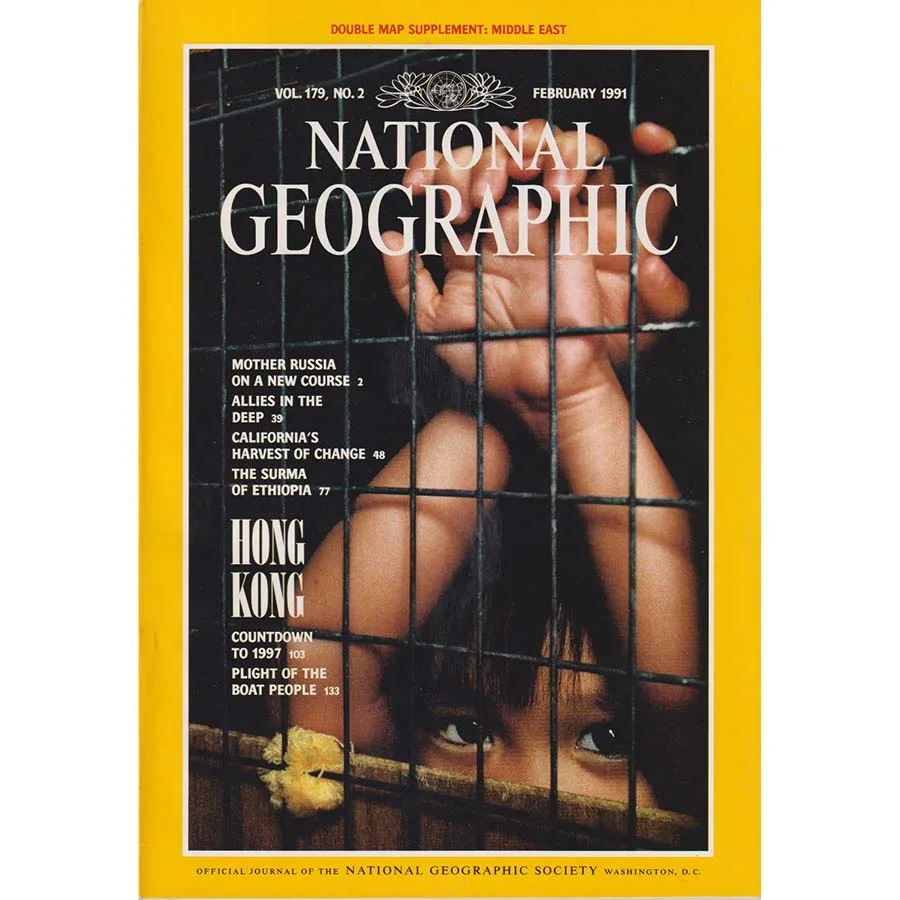
National Geographic, February 1991: the issue that doesn’t bother with subtlety. It puts a child’s hands on a wire grid, a watchful eye peering through, and then calmly titles the main feature Hong Kong: Countdown to 1997—because nothing says “cosy bedtime reading” like geopolitics, uncertainty, and the feeling of history tapping its foot impatiently in the corner.
This is peak early-90s Nat Geo: big transitional moments, captured not as abstract policy, but as lived tension. The “countdown” framing is perfect in the most ominous way—time as a pressure cooker. Hong Kong isn’t presented as postcard glamour (though the city can do glamour with the best of them), but as a place where identity, sovereignty, money, family, fear, ambition, and sheer daily hustle all collide. The cover image does the heavy lifting: confined space, vulnerability, and the quiet question of what happens to ordinary lives when the calendar itself becomes political.
And the irony is that this is a travel magazine issue where the main destination is… a deadline.
But because National Geographic cannot resist variety—because it is constitutionally incapable of publishing a single-theme issue—you also get a glorious supporting cast of features that ricochet around the planet:
-
Mother Russia on a New Course – 1991 was the year where “new course” was doing a lot of work. This is Russia in flux, old certainties dissolving, and the sense that a whole giant system is trying to reinvent itself while still wearing the same heavy coat.
-
Allies in the Deep – the wonderfully vague Nat Geo title that usually means marine life, weird symbioses, and you realising the ocean has been running complex partnerships for millions of years while humans still argue over who should do the washing up.
-
California’s Harvest of Change – agriculture, labour, landscape, economics—California as a living machine that feeds people, consumes water, and constantly remakes itself. The kind of piece that reads like a sunny postcard until you notice the spreadsheets hidden behind the orchards.
-
The Surma of Ethiopia – culture, identity, and a reminder that “remote” is often just a word outsiders use when they haven’t bothered to learn the map properly.
-
Plight of the Boat People – a hard, human story that sits in your chest. Nat Geo doing what it does well: putting faces and details to a crisis people prefer to keep at arm’s length.
And crowning the whole thing: Double Map Supplement: Middle East, because the early 90s truly said, “You will need a map for this decade.” You will unfold it with reverence, then attempt to refold it and discover that cartography is also a form of advanced origami designed to test character. You will fail. Everyone fails. That’s part of the rite.
Condition: Good, which is exactly what you want from a 1991 issue: sturdy, readable, and still full of that old-school National Geographic confidence—big reporting, big photography, big themes, and no fear of letting the world be complicated. Sold by Crappy Old Books, naturally, because the best way to acquire Hong Kong’s ticking clock, Russia’s reinvention, underwater alliances, California’s changing harvest, Ethiopia’s cultural portrait, a sobering refugee story, and a massive Middle East map is from a shop that sounds like it might also sell you a slightly battered atlas and change your evening plans.
If you like your National Geographic with less “ooh, pretty” and more “oof, history”—February 1991 is a sharp, heavy, fascinating slice of a world right on the edge of turning.
Keep browsing: See more National Geographic books Other books by National Geographic
